

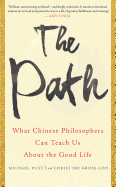
Most philosophy courses begin with big, abstract questions: What is morality? What is the meaning of life? These questions, explains Harvard professor Michael Puett, run opposite to the ideas of Confucius, who was most interested in the simple concerns of everyday life--how to be happy or how to treat other people. Incidentally, these are also the questions Puett frequently hears from his students at Harvard, where he has taught Chinese philosophy for more than two decades. Now Puett, along with journalist Christine Gross-Loh, has boiled down the ideas of his courses in The Path: What Chinese Philosophers Can Teach Us About the Good Life.
Gross-Loh, who holds a Ph.D. in East Asian history from Harvard, first became interested in Puett while writing an article for the Atlantic that sought to explain why a course on 2,000-year-old thinkers had become one of the most popular on campus. Perhaps one reason for this is Puett's ability to understand his audience. In The Path, he addresses the Western reader directly, explaining that many Western ideas taken for granted are the legacy of Protestant values--for instance, the idea that a person has a "true, authentic self" whose purpose he should aspire to fulfill. This notion is in fact incompatible with Confucian thought, which does not see individuals as "fixed" but rather as constantly changing beings with the ability to adapt at any given moment. While The Path is a quick read, the ideas it suggests will likely stick with readers for a long time. --Annie Atherton