

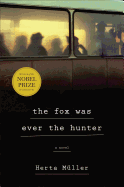
The world of The Fox Was Ever the Hunter is a bewildering and disorienting one, where people turn to superstition to make sense of their lives, where even the poplar trees are menacing--because life is a menace. Here the sunlight is inescapable and beats down on one, mimicking the constant surveillance of the police state and the omnipresent image of the dictator, watching everything and everyone.
Character and narrative are secondary to setting and atmosphere in Herta Müller's novel, translated from the German by Philip Boehm. That setting is Romania, following the agricultural and austerity reforms of the communist dictator Nicolae Ceaușescu. Müller was persecuted there by the secret police and immigrated to West Germany in the 1980s. She won the Nobel Prize for Literature in 2009.
The strong writing contributes to the disjointed and disturbing impressions of both place and character. Use of poetic techniques abound, augmenting the surrealism: "[h]unger sharpens elbows for shoving and teeth for screaming. The shop has fresh bread. The elbows inside the shop are countless, but the bread is counted," and "[e]ven without their leaves the branches overhead are listening in." While the Romania of The Fox Was Ever the Hunter feels surreal, it is very real to the characters, who initially seem like mere paper cutouts. In the last third, however, they begin driving the narrative forward and develop compelling depth. Friends are informers, lovers are traitors, and every day the threat of the state makes both its presence and absolute authority known in increasingly spirit-crushing ways. -- Evan M. Anderson, collection development librarian, Kirkendall Public Library, Ankeny, Iowa.