

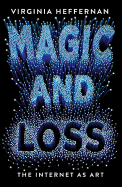
Few amenities have shifted the landscape of modern living to the degree that the Internet has. And though the web boasts manifold interests, generating numerous books about its technological development, user experience, business purposes, potential health hazards and the like, Virginia Heffernan, digital culture writer for the New York Times Magazine, is much more concerned with the Internet's dynamic as a collective work of art.
With her keen focus set in turn on the web's design, text, images, video and music, Heffernan sketches a compelling narrative for that fickle network so many people have grown to depend on, from its creaky days of dial-up and command lines to the sleek information superhighway and app suburbs of Web 2.0. But what most fascinates her is what users have done with it. YouTube, once feared to be the harbinger of Hollywood's doom, serves as an ideal platform for professional music videos and amateur "fail" memes alike. The quality of iPhone photos has spawned monumentally popular apps like Instagram and Snapchat, making image-based networking the prominent paradigm and the text-centric Blackberry a relic of a recent past.
With magical advancements, there come unavoidable losses: the digitization of music cannot capture the full nuance of all sounds; rapid-fire instant messaging diminishes our need for phone calls. "Magic and loss, however, have always coexisted in aesthetic experience," Heffernan concludes. "Maybe they are aesthetic experience." Rather than pit "highbrow" analog against "lowbrow" digital, Magic & Loss suggests that art in the digital era is contiguous to artistic developments of the past. After all, a work of art has always needed its negative space. --Dave Wheeler, associate editor, Shelf Awareness