

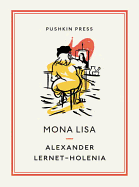
In Mona Lisa, Alexander Lernet-Holenia (I Was Jack Mortimer) explores the power of art to influence life and of life to influence art. Set in the early 1500s, the slim novel opens as a group of French soldiers led by Louis de la Trémouille receive the charge from their king to travel to Florence. There they explore the city, seeking art and treasures, eventually coming to the studio of Leonardo da Vinci, where one of La Trémouille's men, Monsieur de Bougainville, catches a glimpse of da Vinci's unfinished painting of a mysterious smiling woman. That one glimpse is enough to change the course of Bougainville's life, as he falls hopelessly in love with da Vinci's subject and her mysterious, knowing smile.
Unfortunately for Bougainville, da Vinci is unable to confirm the identity of his subject, or even whether or not she was ever real. "After all," the artist explains, "one always paints women who never exist, and the same goes for women one really loves." As Bougainville tears apart the city of Florence in search of his (possibly non-existent) one true love, Mona Lisa builds into an absurd but telling story of art and love and how the two intersect. Bougainville's love is shaped by da Vinci's art; da Vinci's art is shaped by Bougainville's love. Lernet-Holenia's language, translated from the German by Ignat Avsey, is quick and punchy, proving the perfect complement to this entertaining story. Mona Lisa contemplates the origins of da Vinci's painting and his subject, her enigmatic smile and the lasting impact she has had on our imaginations to this day. --Kerry McHugh, blogger at Entomology of a Bookworm