

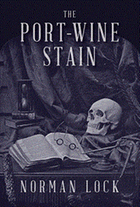
Despite its short length, Norman Lock's The Port-Wine Stain is a powerfully complex novel told in interwoven layers of theme and plot. Written in approachable prose, it opens near the end of the 19th century, in the Philadelphia office where Edward Fenzil practices medicine, fascinated with the more macabre side of human anatomy. But no matter how many bodies he performs surgery on, he can never quite find the part of the soul that leads a man to evil. When a friend comes to visit, Fenzil indulges the man, who never speaks, in a story from his days as a medical assistant, when he got to know the city and became personally acquainted with Edgar Allan Poe. Slowly, Fenzil loses his grip on reality, culminating in a terrifying late-night encounter with a mysterious creature in a morgue.
Thus, The Port-Wine Stain itself begins to read like a Poe horror story. As Fenzil tries to figure out what is real in a world he becomes convinced is inhabited by ghosts and doppelgängers, Lock slowly eases the narrative beyond the doctor's tale and into Poe's territory of psychological trickery. Every scene recalls the question Fenzil asks himself about the nature of evil in man.
The third in a series Lock has called "The American Novels," The Port-Wine Stain fits perfectly with the previous two: The Boy in His Winter and American Meteor. By picking a moment in U.S. history and inhabiting it with the real-life characters that defined the age, Lock allows his readers to explore the development of national identity. --Josh Potter