

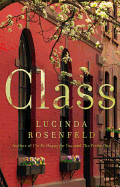
Set in a gentrifying neighborhood of an unnamed city, Lucinda Rosenfeld's Class is told from the point of view of Karen Kipple, a woman in her mid-40s who works as the director of development for a small nonprofit dedicated to eliminating childhood hunger in the United States. Karen's husband, Matt McClelland, has abandoned his job as a lawyer for evicted tenants in order to devote his energies to building a website for low-income city dwellers. The pair lavish most of their remaining attention on their only child, eight-year-old third-grader Ruby.
In their own minds, Karen and Matt's progressive credentials are burnished by their decision to send Ruby to a public elementary school where only 20% of the students are white, convinced she'll receive an "invaluable, once-in-a-lifetime education in multiculturalism and class difference." Among her peers who choose to send their children elsewhere, Karen has two goals: "to foster guilt and shame, and to instill doubt about whatever alternative had been secured."
But when one of Ruby's friends transfers to a less racially mixed school after an incident with an African American classmate, Karen begins to question whether she's sacrificing her daughter's well-being to pride in her principles. On a walk through an adjacent neighborhood, she hatches an audacious scheme designed to safeguard Ruby's education, one that becomes ever more daring as she struggles to be equally protective of her own liberal values. With an acerbic wit and insight revealed in the double meaning of the novel's title, Rosenfeld deftly punctures the hypocrisy that's sometimes exposed in the daunting process of trying to be true to one's professed beliefs. --Harvey Freedenberg, attorney and freelance reviewer