

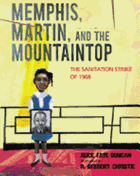
With Memphis, Martin, and the Mountaintop, Alice Faye Duncan, the author of several children's books, takes as her subject Martin Luther King's last campaign, and she makes clear that, while he didn't live to see its outcome, his work was not in vain.
Duncan's text is narrated by a nine-year-old black girl named Lorraine Jackson, whose father is a sanitation worker. In February 1968, Lorraine's dad returns to their Memphis home reporting that two of his coworkers were killed by a malfunctioning garbage truck. There has been talk of a strike--the overwhelmingly black sanitation crew makes outrageously low wages in abysmal working conditions--and these senseless deaths spur action. When 1,300 Memphis sanitation workers strike on February 12, 1968, Lorraine's father is among them.
Organizations including the NAACP show support for the strike, and so does Lorraine's mother: "In her right hand she carried her boycott sign. In her left, she held my hand." Spirits soar when news spreads that Dr. King will be joining the struggle in Memphis. When the march turns violent, King leaves the city and promises to come back; it's after his return that he's killed on April 4. But this doesn't end Lorraine's story.
A memorial march takes place on April 8 to honor the fallen leader, and this time, they're accompanied by King's widow, Coretta Scott King. R. Gregory Christie, whose innumerable illustrator credits include Freedom in Congo Square, displays his unmistakable style: he sets elaborately tended faces and forms against less worked-over slabs of color; in his ennobling art, humanity is always paramount. King's death isn't the main story in Memphis, Martin, and the Mountaintop; it's a tragic part of an inspiring account in which a heroic campaign lost its leader but nevertheless marched on to victory. --Nell Beram, freelance writer and YA author