

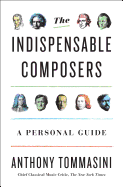
In 2011, New York Times chief classical music critic Anthony Tommasini embarked on a Top 10 Composers Project. It begged a simple but profound question: How do you define greatness, especially in classical music, which "has justifiably been criticized for its obsession" with the concept for centuries? Despite misgivings from some readers, the project drew such passionate responses that it inspired Tommasini to expand his list, and The Indispensable Composers was born.
Tommasini identifies 17 composers who are canonical to classical music (all men, noting that classical music was "especially uninviting" to women). Arranged chronologically and supplemented with colorful biographies, it begins in the 1600s with Monteverdi, instrumental in the development of opera and heralding the modern era of music, followed by Bach and Handel. The classical milieu of Vienna from 1750 to 1825 was monumental, yielding four of the greatest composers--Haydn, Mozart, Beethoven and Schubert. The shift away from patronage during this period allowed composers to publish their music, though many continued to struggle financially. The 19th-century masters--Chopin, Schumann, Verdi, Wagner, Brahms, Debussy and Puccini--alternately honored and challenged conventions, paving the way for the "radical" Schoenberg, Stravinsky and Bartók in the 20th century.
As a pianist, Tommasini is at his best when he's writing about the music itself, whether it's a technique like counterpoint or recalling a favorite recording or live performance. His description of Beethoven's Piano Concerto No. 4 in G Major as a "philosophical and often feisty dialogue" between the piano and orchestra is both authoritative and playful. In fact, listening to a piece of music may be the ideal companion to Tommasini's vibrant narrative. --Frank Brasile, librarian