

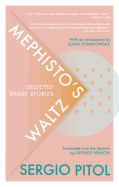
The 13 short stories in Mexican author Sergio Pitol's Mephisto's Waltz share a common thread. They posit stories within stories, narrators upon narrators, until the reader is contending not just with a tale, but an almost-Brechtian structure that reveals the various modes of communicating that tale in the first place. Never content simply to tell a story, Pitol's works instead break down the reasons how, and why, stories are told.
"Mephisto's Waltz," Pitol's purported favorite of the collection, is the best example of this layered storytelling. In it, a woman reads a recently published piece of fiction by her estranged husband, which is in and of itself about a writer who is thinking up a story. Pitol deftly weaves in and out of the different narrative layers, showing the woman's reactions to her husband's work as the story moves through it, giving the reader multiple texts at once to see and respond to.
As noted in the final piece, "The Dark Twin," many of the stories have clear hints of autobiography. Nearly every piece involves a Mexican living in Europe, mirroring Pitol's own travels (each story notes the city of its creation, none of which are outside Europe). And more often than not the narrators are intellectuals or writers, knowledgeable of stories and cultures. However, for every hint of truth there is a moment where the artifice of fiction is laid bare. Framing devices, false stories and more dot the pages of Mephisto's Waltz, always forcing the reader to confront the structures of fiction. --Noah Cruickshank, adult engagement manager, the Field Museum, Chicago, Ill.