

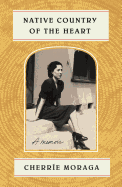
"How to explain the complexity of this? What it means to be not just me but us." Cherríe Moraga asks this--of herself, of her readers, of the world at large--in the prologue to Native Country of the Heart. In the subsequent pages, she documents her coming-of-age as a "Mexican, mixed-blood, queer, female, almost-Indian." But any history of herself, she reasons, is also a history of "she"--her mother, Elvira, who was hired out as a farmhand by her father as a child. Who had an undefined relationship with her white male boss as a teenager. Who both loved and suffered through her marriage to Moraga's father as an adult, and whose role as mother--to the author and her two siblings--is complicated, messy and full of heartache.
Moraga (editor of This Bridge Called My Back: Writings by Radical Women of Color) reflects on her adolescence, and she weaves together her story of growing up with her mother's slow decline into Alzheimer's. As she does so, Native Country of the Heart shifts from pure memoir to something much larger. It's a documentation of a mother and daughter's relationship, true, but also a grappling with the legacy of white American colonialism and the long-fingered reach of historical violence through generations. It does what the best memoirs can do: offers a glimpse into one particular life, but in a way that allows readers to see the world in a slightly different light after turning the last page. --Kerry McHugh, blogger at Entomology of a Bookworm