

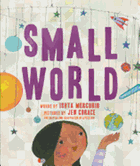
When Nanda is young, "the whole" of her world is composed of comforting circles. Just after she's born, this means being "wrapped in the circle of her mother's arms"; as a toddler, the meaning expands to include "the circle of her loving family." It's not long before Nanda's world encompasses other shapes as well. Nanda gets "bigger and bigger," and her world grows with her. It opens up to include "a sway of branches" and "scaffolds of steel." It continues to increase in size as she rides a train from the "sun-kissed maze of wheat" near her hometown to the "symphony of glass and stone" that defines her college years.
Nanda's lifelong love of science "spool[s] through spirals of wire and foam" at school, yet Nanda and her world continue to grow. As Nanda gets "bigger and bigger and BIGGER," her world becomes "the roar of twin engines, a glittering ocean far below, and the curve of the planet beneath her."
Mercurio's gorgeously poetic text effortlessly balances the wonders of the natural world with the wonders created by scientists and engineers. Her repeating refrain as Nanda gets bigger ensures that this story is comforting to its youngest readers, while including enough variation to inspire older ones. Corace's gouache, ink and pencil spreads are always warm and bright, anchored by geometric shapes and patterns. An author's endnote says that the inspiration for this story came from a photograph taken at the Indian Space Research Organization showing five women "celebrating after they had helped put a satellite into orbit around Mars." Small World, like that photograph, depicts the joy there is to be found when young girls and women "all over the world" follow their dreams. --Lynn Becker, blogger and host of Book Talk, a monthly online discussion of children's books for SCBWI