

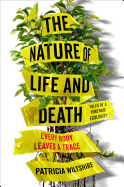
Depending on one's perspective, there are few nicknames greater than "the snot lady," the sobriquet earned by Welsh forensic ecologist Patricia Wiltshire for developing a method to obtain pollen particles from the nasal cavities of the dead. In The Nature of Life and Death, Wiltshire describes that method in terrific detail, part and parcel of her 45-year career studying the world of plants and, since the early 1990s, helping the police solve crimes through ecological trace evidence (pollen, fungal spores, soil, etc.) taken and left behind by victims and perpetrators.
Along with her practical history and pioneering of her profession, Wiltshire walks readers through numerous case studies recounting how her work helped locate a murder victim's body or linked a suspect to a crime. Those interested in plant and animal sciences or forensics will be particularly rapt at the microscopic levels of proof Wiltshire obtains.
Even as she writes for a broad audience, Wiltshire comes across as enigmatic as her subject matter. She writes from a self-centered but somewhat aloof point of view and in a straightforward manner befitting a lecturer. Wiltshire is under no obligation to share herself; her credentials and the case studies speak for themselves. Yet, at the three-quarter mark, she unexpectedly shows her animal-loving side and "explains" her "arrogance." Her disclosures can't help but thaw both writer and reader, serving not to change the absorbing material, but to heighten appreciation and understanding of its source. --Lauren O'Brien of Malcolm Avenue Review