

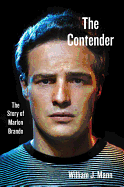
Although both critics and other actors generally acknowledged Marlon Brando as one of the world's finest actors, he consistently downplayed his talent and the acting profession. For decades, the media lamented that he found no fulfillment in acting. But in this outstanding, intelligent and insightful biography, The Contender, William J. Mann (Kate: The Woman Who Was Hepburn) examines Brando's life and passions from a different angle. He posits that Brando found true satisfaction in his fight for civil rights and his relentless commitment to social justice.
Brando (1924-2004) was a complex and sometimes difficult man, but Mann's expert research finds the reasons behind his actions. Brando was a bookworm and "a thinker, an observer, an examiner of himself and the world with the goal of figuring out both," writes Mann. But he was also a sexual adventurer with both men and women.
Playing Stanley Kowalski in Tennessee Williams's A Streetcar Named Desire (on Broadway and in the 1951 film) catapulted Brando's career, yet by the 1960s, few film projects earned his full attention. His 1961 directorial debut, One-Eyed Jacks, was recut by the studio, leaving him depressed and disillusioned. At this point, his political activism began to take center stage. With few exceptions (The Godfather; Last Tango in Paris), his post-1970 films served only to finance his activism, alimony and lifestyle. Mann calls the last 30 years of Brando's life "a catalog of tragedies that approach the Shakespearean."
At more than 700 pages, The Contender is a brisk and adroit read that is perceptive, thoughtful and gives fans a new view of their idol. --Kevin Howell, independent reviewer and marketing consultant