

In 1877, Thomas Alva Edison--already a prolific inventor, though not yet famous--decided to let his latest creation speak for itself. To the disbelief of onlookers, Edison turned on a machine consisting of a mouthpiece, cylinder, crank handle and speaker that "spoke" all by itself. In an instant, the "talking phonograph" changed everything: "Breath has been turned into metal, metal was convertible back into air," and Edison became the Wizard of Menlo Park.
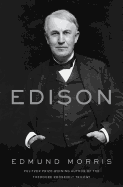
In Edison, biographer Edmund Morris (winner of the National Book Award and Pulitzer Prize for The Rise of Theodore Roosevelt) chronicles the life of the inventor in reverse chronology. Morris begins with Edison in the last decade of his life--"a combination of twinkling charm and bruising imperiousness"--and finishes with his youth--an enterprising teenager who invented the two-way telegraph. In time, the most revolutionary of Edison's inventions come into focus. For instance, the first reliable incandescent light bulb and subsequent centralized lighting system were "so unobtrusive and at the same time so world changing" that the impact was inconceivable. And the Kinetograph, showing a 27-second loop of blacksmiths at work, pulled viewers "into a flickering world where Lilliputian figures moved in chiaroscuro."
Morris, who died in May 2019, clearly admired his subject, but this is no hagiography. Regarded by some as "half genius, half fool," Edison was often in dire financial straits, tussled with partners and competitors, and failed often; his family long suffered from his workaholism. But he was also charming, affable and blessed with a boundless curiosity that allowed his genius to flourish, for which the world would never be the same. --Frank Brasile, selection librarian, writer, editor