

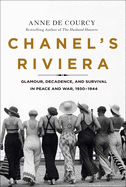
Social historian Anne de Courcy (The Fishing Fleet) adeptly considers the glittering period between the two world wars, when the French Riviera was a society and cultural center of the Western world. W. Somerset Maugham wrote there, Picasso painted there, King Edward VIII stayed there long before he became the Duke of Windsor, and the most famous designer in the world, Coco Chanel, forever changed the way women looked when she allowed her skin to become tan there. It seemed nothing could change the Riviera: not the Depression of 1929, not when France instituted a national vacation that brought hordes of working-class tent campers to the beaches for two weeks every year, not even when Jewish refugees like Thomas Mann and Vladimir Nabokov arrived in flight from Hitler's Germany. The Maginot Line would protect them, Riviera inhabitants claimed, right up until Germany invaded France. Within six weeks, France surrendered and no place in the nation remained unchanged.
The Duke and Duchess of Windsor left for the safety of Spain, carrying their household in a convoy of four cars and a truck. Those who remained on the Riviera ended up trading their clothes for food. Malnutrition became so prevalent that one doctor called it "La maladie à la mode."
De Courcy deploys gleaming, well-chosen details to make Chanel's Riviera as vivid and entertaining as a novel. Her careful research, coupled with her polished narrative style, illuminates an era of opulence and starvation, of heroes and collaborators, in a world that soared high and swiftly plummeted. --Janet Brown, author and former bookseller