

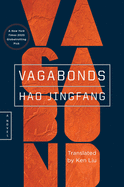
Hugo Award-winner Hao Jingfang's Vagabonds is a science fiction epic that doubles as a work of philosophy--a novel filled with big ideas about art, competing cultures and so much more. Translated by Ken Liu (The Hidden Girl), Hao's novel takes place at the beginning of the 23rd century, on a colonized Mars that broke away from Earth many years earlier, after a destructive war.
In an attempt to thaw relations between Mars and Earth, a delegation of young Martians was sent to live on Earth for five years. Vagabonds begins with their return to Mars, many of them unmoored by their experiences in a very different culture. Luoying returns unsure of her place in either world, disturbed by assertions on Earth that her grandfather, the consul of Mars, is a dictator. Meanwhile, Eko, a documentarian from Earth, finds Mars a utopia of artistic expression, unconstrained by the demands of capitalism. As Eko attempts to follow the footsteps of his old teacher, and Luoying learns more about her deceased parents, the author unfolds revelations and complicates each of their perceptions of Mars.
Vagabonds is sometimes reminiscent of old-school sci-fi. Hao thankfully avoids the all-too-common habit of making one character her obvious mouthpiece; instead, it's often unclear who is right and who is wrong. Even Luoying's grandfather, the alleged dictator, is treated sympathetically and given a fully coherent ideology. In Vagabonds, the conflict between Earth and Mars is no more important than the conflict between the novel's characters as they struggle to chart a course for their future. --Hank Stephenson, manuscript reader, the Sun magazine