

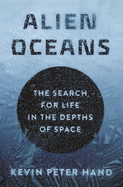
In Alien Oceans: The Search for Life in the Depths of Space, Kevin Hand, a scientist at NASA's Jet Propulsion Laboratory, outlines the latest evidence regarding undersea extraterrestrials and speculates what else science may uncover. If alien life exists inside our solar system, it will likely be found in oceans of liquid water encased in shells of solid ice. Evidence shows that several moons around Jupiter and Saturn--particularly Europa, Titan, Enceladus and Callisto--harbor interior oceans in which life may have evolved despite a total lack of photosynthesis. Robust ecosystems surrounding heat vents in the sunless depths of Earth's oceans suggest that these far-flung satellites, so seemingly inhospitable to humans, could contain microbes or even complex organisms.
Hand demonstrates how we know these oceans exist in the first place via mass spectrometry, gravitational and magnetic readings. He then examines the chemistry at work on these worlds and how life might adapt to those conditions, acknowledging that the sample size of one--life on Earth--makes speculating about alien biology difficult, and that life may ultimately take surprising forms. One major unknown is the origin of life, whether the process of ubiquitous organic compounds developing into replicating cells is common or rare. It is possible, he admits, that Europa's salty seas may be barren, but Hand's comprehensive arguments leave one suspecting otherwise. Alien Oceans successfully straddles a fine line between accessibility and scientific thoroughness. Hand's book is as fascinating as it is optimistic. --Tobias Mutter, freelance reviewer