

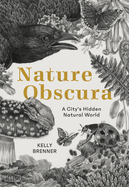
When considering places to discover the wonders of nature, cities are often dismissed as little more than havens for rats and pigeons. But as naturalist Kelly Brenner shows readers in Nature Obscura, urban areas are surprisingly fertile grounds for the citizen scientist to explore.
Using her hometown of Seattle as a guide, Brenner surveys the city's flora and fauna through the four seasons. Anna's hummingbird, a fairly recent arrival (1965) to the Pacific Northwest, must eat double its body weight every day in order to survive, while the moon snail takes two weeks to consume a clam. The resilient muskrat has acclimated to a changing landscape by creating new dens and adapting to different food sources, while the ubiquitous crow finds the city less threatening than the countryside. But it's the smallest creatures among us that excite Brenner the most. The microscopic tardigrade, found in Brenner's rooftop moss, has survived mass extinctions; also known as a water bear, it's cute to boot. On the opposite end of the spectrum is Fuligo septica, more commonly known as the dog vomit slime mold--but not all slime molds are alike; one species of Craterium looks like "a champagne flute filled with fireworks."
Brenner brings an infectious curiosity to urban nature--whether unpacking how the tiny stickleback fish has, in a rare case of reverse evolution, transformed to lose and regrow its plates of armor in response to pollution, or considering whether lichens really ever die, as they increase reproduction the older and larger they get. With Nature Obscura, readers need not venture far to discover a natural world teeming with life. --Frank Brasile, librarian