

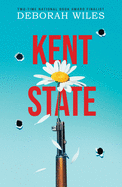
National Book Award finalist (for Each Little Bird that Sings and Revolution) Deborah Wiles's passionate, multifaceted Kent State chronicles "those four days in May 1970 when America turned on its unarmed children... and killed them."
After a straightforward introduction that traces the actions that led to the murder of four Kent State students, Wiles delivers an unusual and theatrical reading experience. One of the many plural narrators addresses the reader: "we will start by telling you what is most important: They did not have to die." Another plural narrator, distinguished by a different font and placement on the page, appears and argues with the first. As Wiles's first and second narrators attempt to give their own accounts of what led to the Ohio National Guard killing four protesting students, more narrators announce themselves. Memories are muddled, tensions are high, facts are confused--it feels like a literary mix of Thornton Wilder's Our Town and a CNN six-person split-screen.
That is the point. Wiles states in a note that she knew she would never "be able to do [the students'] stories justice, or tell definitively what happened, because there is so much unknown." Instead, she aimed to include all voices and all memories; she represents students, townspeople and members of the National Guard. The chaotic nature of the words on the page symbolize and mirror the tumultuous feelings of the event. And, even though the narrators directly address recent acts of violence and hate, the nature of the book--the lack of discussion, the disagreement on the facts--drives home Wiles's desire to connect the past with the present. It is only on the day the National Guard opens fire that the many voices become one and reader is reminded, fiercely, painfully, that "they did not have to die." --Siân Gaetano, children's and YA editor, Shelf Awareness