

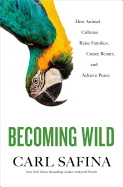
Ecologist Carl Safina (Beyond Words; Eye of the Albatross) shines a light on the intricacies of animal cultures in his engaging and eye-opening 10th book, Becoming Wild.
"From one another we become who we are." Humankind is not alone in its development of culture, as Safina demonstrates through his exploration of three distinct animal types. Through the use of social learning, sperm whales are culturally "their own mosaic of learned traditions," sharing genetic code across the species but maintaining different identities and behaviors from clan to clan. "Bright splashes of extravagance," the beauty of colorful macaw parrots in the Peruvian Amazon defies expectations of traditional evolutionary theory, implying the importance of cultural selection in evolutionary development. The male-dominated and often violent clans of chimpanzees in the Budongo Forest of Uganda demonstrate the importance of reconciliation in cultures of high-level conflicts, necessitating a complex social web of relationships and "the knowledge of mothers conveyed to children through ages of deep, wild history."
Alternating measured discussion of compiled research (scientific, historical and literary) and more exuberant personal exploration of his firsthand field experience, Safina celebrates the phenomenon of cultural diversity. Culture, he asserts, is not limited to humankind and does not make us superior to other animals. Chimpanzees, for instance, are not the "harbinger of humankind" but rather our evolutionary contemporaries, evolving laterally to humans and with just as much complexity.
Safina's enthusiasm for the animal kingdom is contagious, and his clear writing makes his wide-reaching subject both approachable and tangible. Genetic and cultural evolution have been, as he says, "a long, strange trip. But here we are, all together now." --Jennifer Oleinik, freelance writer and editor