

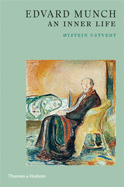
"All art like music must be created with one's lifeblood," Edvard Munch (1863-1944) declared in a note in the early 1890s. Øystein Ustvedt, curator at the National Museum in Oslo, offers a vital, approachable introduction to the celebrated expressionist--best known for The Scream, that howl of despair beneath a sky of undulating orange--that demonstrates how the painter lived that precept.
Munch strived over his half-century career to create emotional, subjective art based on existential experiences, to capture on his canvases what the novelist Knut Hamsun, a contemporary of Munch, deemed "the unconscious life of the mind." Artists in Munch's hometown Kristiania (now Oslo) recognized his genius early, even as critics and authorities in the late 19th century at first found his work too raw, too frank and often not convincingly finished. Edvard Munch: An Inner Life, Ustvedt's affordable study, presents 130 images of Munch's paintings, illustrations, prints and photographs whose chronological arrangement confirms that, from the start, the artist imbued his work with that lifeblood. The haunting The Sick Child (1885-86) confounded Kristiania with its rough brushstrokes, which draw attention to the impassioned creation of the painting itself--and stir subjective feeling that the works of the realists could not. Munch's depictions of bohemian life would likewise arouse controversy, including denunciations right into the 20th century.
Ustvedt's examination of Munch's career touches on all the biographical turning points--Munch was broke for much of his life--but is keyed above all else to the work. In Alison McCullough's translation, techniques, breakthroughs, symbols, controversies and the artist's lifeblood all get illuminated in prose of rare clarity. --Alan Scherstuhl, freelance writer and editor