

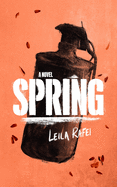
Spring by Leila Rafei adeptly casts the Arab Spring uprising as a backdrop for upheaval in the lives of three ordinary people in her extraordinary debut novel.
In 2011, young people descend upon Tahrir Square in Cairo to demand a new government. "The chant rang out again and again. The people demand the fall of the regime." Sami, an Egyptian university student, dimly registers the protesters in the streets although his classes are canceled because of them. Jamila, a Sudanese refugee, is seeking permanent asylum. The violence in the streets is an enormous inconvenience as she moves around the city. Suad, Sami's mother, watches the uprising on television. As far as she's concerned, "in Tahrir there were only hooligans, young men with too much time on their hands and too little money in their pockets."
Sami breaches Islamic culture by living with Rose, his pregnant American girlfriend. On top of that guilt, he feels no ideological connection with the protesters and initially avoids Tahrir Square. Yet as his relationship with Rose ends along with the regime, he's drawn to it. Suad is a religious woman worried about Sami neglecting his faith. Meanwhile, Jamila cleans house for Sami and Rose, witnessing the privilege that they take for granted. She avoids the revolutionaries--their cause is not her cause--but she can't ignore them, either.
Spring is an impressive debut novel that combines the urgency of literary fiction with the timelessness of historical fiction. --Cindy Pauldine, bookseller, the river's end bookstore, Oswego, N.Y.