

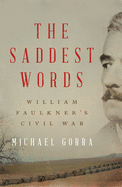
The two saddest words referred to by the title of this sweeping, multi-disciplinary study of the centrality of the Civil War in the imagination of American literature's great Southern modernist? Was and again, as identified by the doomed Quentin Compson in Faulkner's The Sound and the Fury. Words that, together, capture that Southern sense of the past--and its tragedies, failures and injustices--being fixed but also suffocatingly present.
Critic Michael Gorra's momentous, highly readable study, The Saddest Words, illuminates how the Civil War pulses in Faulkner's Yoknapatawpha cycle in a persistent present tense, shaping the consciousness (and cataclysms) of 20th-century characters. Faulkner rarely depicted the war directly, though the South's defeat, the brutality of Reconstruction and the triumphal myth of the "Lost Cause" defined his world. Gorra (Portrait of a Novel) fills in this lacuna by drawing on biography, Civil War history and close readings of the likes of Absalom, Absalom! and The Unvanquished to argue that Faulkner's fiction exposes deep, ugly truths about race and injustice in the antebellum and Jim Crow South. He suggests, persuasively, that Faulkner the writer saw clearly what Faulkner the citizen, a man predisposed to the prejudices and assumptions of his milieu, looked past. Gorra's book does far more than explain the references to Pickett's Charge and the battle of Vicksburg that pepper Faulkner's fiction. It offers a clarifying lens for understanding the books, the history, the man and the nation, and the failings of each, while challenging readers to resist the temptation to cancel an author who didn't always live up to his own genius. --Alan Scherstuhl, freelance writer and editor