

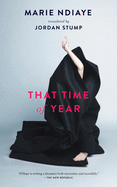
Scarcely more than 100 pages, That Time of Year by Marie NDiaye (Ladivine) might initially seem spare. The intriguing complexity, however, contained in her superb novel underscores again why she is one of France's most lauded contemporary writers, having received her country's highest literary honors, including the Prix Femina and the Prix Goncourt. NDiaye's taut, noirish horror, complicated by Kafka-esque obstacles, is seamlessly translated into English by professor Jordan Stump.
For 10 summers, Herman has traveled with his wife, Rose, and their son to a remote village where the family has a summer home. As Parisians, Herman and his family are still considered tourists by the locals and, as such, are expected to leave by August 31. This year, however, they've veered from predictable habits and stayed an extra couple of days.
That September 1 afternoon, mother and son venture out to buy eggs. Hours later, they have not returned. The sunny warmth that's always lasted, as least through August 31, has suddenly turned to cold rain. Worried, Herman visits the neighboring farm, but the surprisingly inhospitable woman there insists she hasn't seen his family, nor does she even offer him dry shelter. He searches to no avail. Only the Chamber of Commerce president seems to be willing to help. His bizarre edict that Herman must "become a villager [him]self--invisible, insignificant," is Herman's only hope of family reunion. And so, he stays.
Reminiscent of a Beckett play--NDiaye is also a notable playwright--this surreal narrative quickly devolves into a nightmarish fever dream. With adroit precision, NDiaye transforms Herman's situation into a biting, brilliant exposé on class and privilege. --Terry Hong, Smithsonian BookDragon