

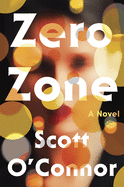
Scott O'Connor's Zero Zone sets itself apart from the literary thriller pack thanks to its highly original premise and empathetic range. The author of Half World and Untouchable, O'Connor once again plumbs the depths of trauma with careful attention to psychological detail. Zero Zone's central narrative follows the installation artist Jess Shepard in late-'70s Los Angeles. Jess has become a figure of unwanted celebrity after a strange series of events at her desert art installation, Zero Zone, culminated in a cult-like group barricading themselves inside. Several years after she was attacked by a survivor, Jess is preoccupied with the imminent release of her attacker from prison, as well as her own complicated feelings of culpability for the events at her installation.
O'Connor approaches the story from various angles: brief, punchy chapters skip back and forth in time and among a half-dozen characters' points of view. O'Connor excels at sympathetically depicting the extremes of human thought, building careful psychological portraits of characters yearning for something like transcendence. Zero Zone shows how its damaged characters' beliefs that "this world was simply a mask hiding another, more beautiful place" led to the shocking events at the installation. O'Connor takes care not to paint anyone as an uncomplicated villain, an approach that pays off as the novel becomes a reflection on forgiveness, letting go of the past and healing. While it builds to a suitably harrowing climax, Zero Zone quickly reveals itself to be a meditation on art in the body of a thriller. --Hank Stephenson, manuscript reader, the Sun magazine