

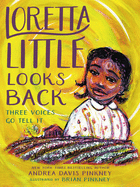
"So name it what you want. Call this oration. Truth-talking. Preaching. Speechifying. Testimony. Recollection." Indeed, Loretta Little Looks Back, the vivid tale of one Black family's multi-generational experience living as sharecroppers in Mississippi, feels distinctly more aural than written. Coretta Scott King Award winner Andrea Davis Pinkney (Martin Rising) uses three vignettes to recount chronologically the triumphs and tribulations of Loretta, Roly and Aggie B. Little.
The opening scene is told by Loretta, who sets the tone for the struggling Black family living in poverty on white people's land. Her adopted brother, Roly, follows, his perspective providing an amiable yet stoic bridge between Loretta's harrowing tale and that of his tenacious daughter, Aggie B. The book draws to a close with the three reunited and resolute to continue the fight for equality.
The lyricism Pinkney infuses into each character's monologue-like exposition well suits a middle-grade audience, presenting in an age-appropriate format difficult subject matter such as the violence surrounding the civil rights movement. The book also contains extensive backmatter--an author's note, an artist's note, "real-life notables" mentioned in the book and explanations of "The Dramatic Form" and "Sharecroppers in the American South." Coretta Scott King Illustrator Award-winner and Caldecott Honor artist Brian Pinkney (who illustrated Martin Rising) "drew inspiration from the gels used in theatrical lighting" and used opaque watercolors and India inks to enhance the dimension and emotion in the characters. His illustrations provide an artistic levity to the intense subject matter, gently reminding readers that there is beauty to be found even while dealing with life's hardships. --Rachel Werner, Hugo House and the Loft Literary Center faculty