

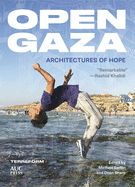
Open Gaza: Architecture of Hope, edited by architect Michael Sorkin (who died last year) and Deen Sharp of the Terreform Center for Advanced Urban Research, is an impressive, substantial collection of essays and speculative designs demonstrating how Gaza, considered one of the most beleaguered environments on Earth, may be renewed and positioned for a socially and spatially just future.
The underlying premise of Open Gaza is that the West Bank and Gaza are more than occupied territories under siege, and their existence is not defined solely by Israeli domination. Terreform, a nonprofit focused on socially equitable urbanism, brought together scholars, architects, planners and activists from Palestine, Israel, the U.S., India and elsewhere and challenged them to imagine how life could be improved for Gazans now within the limitations imposed by Israel, and to reach beyond the endless war and imagine the region in a future without conflict.
The result is an ingenious compilation of ideas, including photographic renderings of a "city of crystal" where glass is deployed as part of the rebuilding strategy to allow the region's destruction to remain visible. The irrepressible spirit of the Palestinian people serves as inspiration for media scholar Helga Tawil-Souri's proposed "Internet Pigeon Network," a self-reliant, Israel-free means of sending and receiving data in Gaza.
Open Gaza offers readers interested in the geo-political history of this region an opportunity to engage with creative projects that, even if they are never fully realized, are, merely by their existence, an act of resistance. --Shahina Piyarali, reviewer