

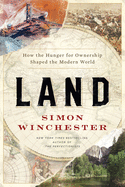
Except perhaps when the earth shakes, most people don't devote a lot of thought to the ground beneath their feet. That may change for anyone who has the pleasure of reading Simon Winchester's informative and thought-provoking survey Land: How the Hunger for Ownership Shaped the Modern World.
Winchester (Atlantic) admits he became "transfixedly fascinated with the notion of land ownership, and of how such a thing could possibly be," after his first purchase--123 acres of unimproved woodland in upstate New York, in 1999. For all the subject matter his book covers, he is most passionate when it comes to describing how peoples like Native Americans, New Zealand's Maori and Scotland's humble crofters have been ruthlessly ejected from lands they once possessed, though the idea of actual ownership was alien to them. In doing so, he lays bare the injustice of the 1889 Oklahoma land run; the duplicity of the still-disputed Treaty of Waitangi, which established British sovereignty over New Zealand in 1840; and the brutality of the Highland clearances of the 19th century. Winchester is equally instructive when he's describing the massive Dutch project to reclaim land from the North Sea and the catastrophe set off by retired British lawyer Sir Cyril Radcliffe, with his ill-conceived line partitioning India and Pakistan in 1947.
Whether nations, tribes or individuals are coveting it, fighting over it, losing it or gaining it, land will always possess the power to excite the human imagination. One couldn't ask for a more accessible or comprehensive treatment of the subject than Simon Winchester's book. --Harvey Freedenberg, freelance reviewer