

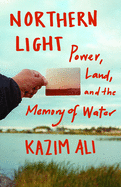
In Northern Light: Power, Land, and the Memory of Water, Kazim Ali explores how a sense of place shapes one's identity. "I've always had a hard time answering the question, 'Where are you from?' " he writes. Born in the U.K. to political refugees from India, Ali eventually migrated to Canada with his family. There, his father worked as an electrical engineer for Manitoba Hydro, the province's electrical authority. Decades later, Ali finds himself recalling his childhood years in the remote town of Jenpeg with fondness, "drawn back to a place that for years I had not thought of."
Jenpeg, however, is gone, having been constructed to last only as long as Hydro needed employees in the area to build a dam across the nearby Nelson River. The town site, on unceded Pimicikamak Cree land, is hours from the nearest provincial town, but the town of Cross Lake, on the Cross Lake Indian Reserve, is much closer, and so Ali ends up visiting there to learn more about his childhood home. He is welcomed and embraced by the people of Cross Lake, who open his eyes to a place steeped in centuries of systemic racism and discriminatory policy.
In Cross Lake, Ali finds himself "awash in remembrance"--of his childhood memories, but also in the collective memories of the Pimicikamak Cree people who still live there and hold the memory of the land in their stories. This remembrance forms the backbone of Northern Light, as Ali moves from writing a memoir to something else, something larger than the story of one person, one family, or even one place. --Kerry McHugh, blogger at Entomology of a Bookworm