

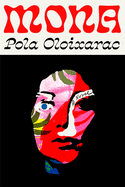
The woman at the center of Mona by Pola Oloixarac (Dark Constellations), translated from Spanish by Adam Morris, is a young Peruvian writer who gigs as a "vraie [true] littérature" academic at teaching posts around the world. She's one of a small group of international writers nominated for a distinguished Swedish literary award, and as she arrives in Sweden, she hopes that a win, with its monetary prize, will give her freedom to leave academia. What at first seems to be a set piece in the rarefied world of ambitious literary types evolves into a psychological exploration of how performative behavior can substitute for authentic living.
Once in Sweden, Mona "luxuriate[s] in her own exoticism, gliding freely through her very own ocean, feeling special and unique." Yet Oloixarac makes sure that readers see through Mona's egocentrism, using other characters as mirrors to show how she appears to those around her, and it isn't always pretty. "You're a complete caricature of a woman," she is flatly informed by Lena, a European writer. Mona is almost always high, frequently drunk and her graphic hypersexuality turns out to be, unsurprisingly, horrifyingly dangerous. Her inner life, revealed by the narrator, underscores how little energy she invests in connecting with those around her.
It's true that the other writers seem to be playing at age-old literary types--the hedonist, the contrarian, the celebrity--but Mona's dispassion protects her from the work of burrowing deep into her own consciousness. With controlled emotion that builds to a devastating ending, Mona uncovers the complexities of a post-feminist generation. --Cindy Pauldine, bookseller, the river's end bookstore, Oswego, N.Y.