

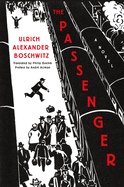
In this restored version of his novel, nearly lost in the late 1930s, Ulrich Alexander Boschowitz delivers a vivid and disquieting account of German society's deterioration in the aftermath of the Kristallnacht pogroms. At the novel's outset, Otto Silbermann has fared better than many other Jews in Berlin, as an affluent businessman and a veteran of the Great War. Otto's middle-class respectability has shielded him from the worst of the Nazi party's encroachments. But in November 1938, as widespread acts of antisemitic violence erupt across Germany, Otto's illusions of security are shattered: "I no longer have any rights," he reflects, "and it's only out of propriety or habit that so many act as though I did."
Otto narrowly evades the storm troopers who arrive at his home to arrest him, and boards one train after another in search of respite from his persecution. Turned away by trusted friends and associates, he finds that constant movement is his only chance at safety: "I am no longer in Germany. I am in trains that run through Germany. That's a big difference." As fear and exhaustion threaten to sabotage him, Otto tries to hold together a sense of himself that seems constantly on the verge of unraveling. Boschowitz relates this fight for self-preservation--not just of life, but of identity--in harrowing psychological detail.
Boschowitz's novel, originally drafted in the weeks immediately following Kristallnacht, was thought lost after the author's death in 1942. Recovered and revised in 2018 and appearing here in a translation from the original German by Philip Boehm, The Passenger is an arresting glimpse at a pivotal and disturbing moment in history. --Theo Henderson, bookseller at Ravenna Third Place Books, Seattle, Wash.