

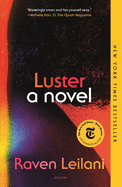
Raven Leilani's first novel, Luster, is a rocket-paced, sensual fever dream of sex, trauma, relationships and conflicting perceptions.
Edie is in her 20s and struggling, with her crappy shared Bushwick apartment, her low-level position in children's publishing, her uninspired sexual choices and her irritable bowel syndrome. Her painting is not going well, and she is a Black woman in New York City: "Racism is often so mundane it leaves your head spinning, the hand of the ordinary in your slow, psychic death so sly and absurd you begin to distrust your own eyes." Early on, her affair with Eric seems different, refreshing, in spite of the 23-year age gap. Then Edie gets fired and evicted, and she spirals, landing, weirdly, in the middle of Eric's open marriage. His wife, Rebecca, set a lot of rules for his relationship with Edie. But Edie finds herself taken in, literally, by Rebecca, living in their guest room in New Jersey, asked to mentor this white couple's adopted Black daughter, Akila.
Edie's first-person narration is nearly stream-of-consciousness, long sentences overflowing with imaginative visual impressions and self-deprecation. Her particular blend of despair, panic and self-destruction is spellbinding. As she hesitatingly helps Akila with her hair and accompanies Rebecca to work (conducting autopsies at the VA) and to a midnight mosh pit, Edie begins to paint again, inspired by the minutiae of this family home.
A Shelf Awareness Best Book of 2020 and winner of the John Leonard Prize from the National Book Critics Circle, Luster is intoxicating and surprising, never letting readers settle into recognizable patterns. Leilani has crafted an unforgettable novel about a young woman making her own way. --Julia Kastner, librarian and blogger at pagesofjulia