

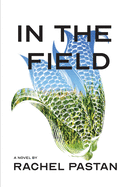
"What if Cinderella had asked her mother's tree to give her a microscope instead of a ballgown?" With In the Field, Rachel Pastan (Alena) offers a compassionate, clear-eyed story of self-determination, love and science. The novel begins in 1982, when Dr. Kate Croft receives a phone call from the Nobel committee, then rewinds to 1923, when Kate is a first-year student at Cornell University, to the disapproval of her family, male professors and classmates.
Kate is entranced by biology, if not obsessed: "The cell was an uncharted country, and she was an explorer newly landed on shore... that was part of the joy of it." Socially challenged and estranged from her family, she grows up with a single-minded devotion to her work, despite the struggles of being a woman in a male-dominated field and her difficulties in love.
An author's note acknowledges that Kate Croft is based on Barbara McClintock, but Pastan makes clear that this is a heavily fictionalized account of the geneticist's personal life, while remaining accurate to the science. Kate is a "corn man," in the parlance of the day, studying maize genes at Cornell's College of Agriculture. Kate's greatest joy is in carefully tending her corn, her slides and her data. Other scientists profit off her discoveries (she is a gifted researcher) and deny her credit; she has difficulty accepting help.
In the Field excels in its multifaceted view of a complex woman. Readers will be better for time spent with this patient, tender, loving examination of a life devoted to examination of life. --Julia Kastner, librarian and blogger at pagesofjulia