

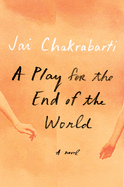
Time, geographies and backgrounds flow effortlessly through Jai Chakrabarti's exquisite debut novel, A Play for the End of the World. At its core is the provenance of a possible love story between two strangers in New York City. Interwoven into this uncertain romance are two all-too-real, grievous world events--the Holocaust in Poland and the Communist Naxalite insurgencies in 1970s West Bengal, India. The eponymous play--Dak Ghar by Rabindranath Tagore--staged 30 years and thousands of miles apart, will prove to be the unlikely connector between the two shattering histories.
Jaryk Smith arrived in the U.S. in 1946, at age 13. He wasn't alone--he had Misha by his side. They were each other's "only family" since meeting at the orphanage founded by Janusz Korczak, known as Pan Doktor, who cared for hundreds of Jewish children in the Warsaw ghetto. Jaryk was one of Korczak's orphans; Misha, a decade older, was a frequently helpful orphanage graduate-of-sorts. In July 1942, Korczak staged a production of Dak Ghar; he hoped the play, "about a dying child living through his imagination while quarantined," might "help his orphans reimagine ghetto life and... prepare them for what was to come." Nine-year-old Jaryk was Amal, the dying child.
After decades shared together as Americans, an upcoming production of Dak Ghar, tragically, separates Misha and Jaryk, when a visiting Indian professor at Columbia enlists them to help stage the play in a rural Indian village threatened by a corrupt government targeting insurgents.
Chakrabarti, born in Kolkata and living in Brooklyn, N.Y., creates a gorgeous international, intercultural mosaic. Elegantly assured, Chakrabarti's storytelling proves revelatory. --Terry Hong, Smithsonian BookDragon