

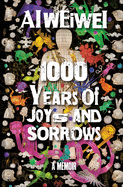
The Chinese artist Ai Weiwei has always found inspiration in unlikely places: "The idea of writing this book came to me after I was taken into police custody in 2011," he writes in his acknowledgments for 1000 Years of Joys and Sorrows. "During that period of enforced isolation, I felt a need to think through my relationship with my father, Ai Qing." The upshot is an extravagantly rewarding hybrid: a combination history of modern China, biography of a dissident poet and memoir by his provocateur son.
The celebrated poet Ai Qing (1910-1996) was an open critic of the Communist government, putting him in the crosshairs of Chairman Mao's Anti-Rightist Campaign, which targeted outspoken intellectuals. The author's own story begins toward his book's midpoint: born in Beijing in 1957, Ai pursued the arts and went to the United States in 1981 with intent to become "a second Picasso." He ended up forfeiting his scholarship to Parsons School of Design, but stayed on in New York, where the 1988 riot in Tompkins Square Park awakened him to the galvanizing beauty of protest movements. After Ai returned to Beijing in 1993, he worked as an architect and committed himself to "little acts of mischief." He embraced blogging in 2005, using it for activism, as when he launched a campaign to hold the government accountable for the deaths resulting from 2008's Wenchuan earthquake.
A rousing but even-tempered call to action, 1000 Years of Joys and Sorrows also succeeds as something uncharacteristically modest for a work by Ai, known for commanding installations like his 2010 Tate Modern exhibition of 100,000,000 ceramic sunflower seeds: his book is the story of an artist finding his voice. --Nell Beram, author and freelance writer