

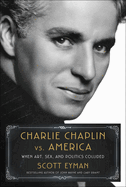
In Charlie Chaplin vs. America: When Art, Sex, and Politics Collided, Scott Eyman describes the Tramp, the filmmaker's bowler-hat-wearing, cane-carrying signature role, as "a well-meaning outsider at perpetual cross-purposes with his surroundings, doomed to isolation because of a basic imbalance in the relationship between an individual and conventional society." That's not a bad description of the Tramp's creator, as Eyman makes painfully clear in his layered and cautionary look at Chaplin, the most famous victim of mid-century America's Red Scare.
Chaplin (1889-1977) was born into poverty in London. In 1906, the teenager joined a comedy troupe that toured the United States. Chaplin proceeded to produce and star in movies that had broad appeal, but some members of the public took issue with his personal life. Although blood tests occasioned by a paternity suit that went to trial in 1944 proved that Chaplin wasn't the father of his sometime girlfriend Joan Berry's baby, he lost "in court and, far more damagingly, in the court of public opinion," Eyman writes. The public's certainty of Chaplin's moral deviancy fueled an overzealous FBI already on the Communist-hunting warpath.
Eyman (Cary Grant: A Brilliant Disguise; Hank & Jim) has the finesse to shape Charlie Chaplin vs. America into a sympathetic portrait without overlooking his subject's moral squishiness. He writes that Chaplin's is "the story of one of the earliest junctions between show business and politics," and it's certainly an early example of cancel culture--not an outcome one might have anticipated for Chaplin, given that, in Eyman's words, "the foundation of his work was the pain of abandonment seasoned by compassion and kindness." --Nell Beram, author and freelance writer