

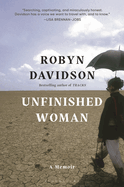
For years, Robyn Davidson (Desert Places; Tracks) has tried to write about her mother, a woman who hanged herself from the garage rafters with an electric kettle cord when Davidson was young. This is not a spoiler: readers will find this fact in the prelude of this finely textured memoir. Writing about an event Davidson describes as feeling no emotion for ("when I touch the area around that day, I can feel only callus") is tricky terrain, and yet Davidson pulls it off, helped by her curious and philosophical mind and precise choice in words.
In Unfinished Woman, the idea of memory and narrative--and how writing can reshape memory--is as much of a subject as the author's mother. Davidson probes her childhood and, later, her adulthood, searching for the truth about her mother's life--and her own: "What is the relationship between my mother's despair, and my own?" Readers of Davidson's work will find some similar themes, namely her peripatetic life and her interest in traditional nomadic cultures. However, in Unfinished Woman, her focus is on what caused her independence in the first place and how that self-reliance in later years turns detrimental to her mental well-being.
Although this is not a memoir with a hopeful message or tidy ending, Davidson infuses her sometimes-dark sentiments with a healthy dose of pragmatism. She writes: "People given to regret tend to forget that the road not taken might have turned into a dead end round the first bend." --Nina Semczuk, writer, editor, and illustrator