

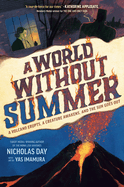
Nicholas Day, the Sibert Medal-winning author of The Mona Lisa Vanishes, explores the catastrophic, worldwide results of the 19th-century Tambora volcano eruption in his middle-grade nonfiction book A World Without Summer, illustrated by Yas Imamura (Love in the Library).
Mount Tambora on Indonesia's Sumbawa Island had been inactive for 400 years before April 1815, when "it began to rumble." On April 10, "Tambora blew itself apart.... It was as if the earth had been turned inside out and its glowing center was now on the outside." The volcano, with a 27-mile-high plume, decimated the island and boiled the sea. The eruption released 100 million tons of fine ash particles and sulfuric acid, which entered the stratosphere and created a "veil" that altered Earth's climate, destroyed crops, reshaped seasons, and caused famines. The veil covered the sun around the globe, leaving people to theorize what could have caused the sun's "eclipse" (Sunspots? Lightning rods? The wrath of God?). At this time, a young Mary Shelley was traveling in Switzerland and saw starving people everywhere attempting to survive destructive, powerful storms. This world gone wrong--along with a contest initiated by Lord Byron--inspired her to write Frankenstein.
Day's exemplary research and stunning facts about the Tambora eruption (with sources identified in extensive back matter) make for a gripping reading experience as well as a strong warning: altering climate can produce deadly consequences on a global scale. Imamura's grayscale illustrations help set tone (a diaphanous cloud of black and gray opening every chapter) while spot art highlights the human experience. A World Without Summer is a dramatic, enlightening work of nonfiction. --Jen Forbus, freelancer