

 |
|
| Amelia Thomas | |
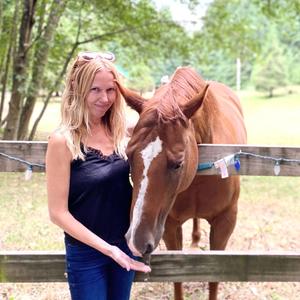
Amelia Thomas has contributed to more than a dozen Lonely Planet books. Her journalism has appeared in the Christian Science Monitor, CNN Traveler, the Middle East Times, the Sunday Times, and the Washington Post. Her previous book, The Zoo on the Road to Nablus (2008), inspired the documentary Waiting for Giraffes. Thomas attended Cambridge University and holds a diploma in equine psychology. She lives on a farm in Nova Scotia and practices equine bodywork for charitable organizations. Her new book, What Sheep Think about the Weather (Sourcebooks, November 4, 2025), delves into human-animal communication.
Would you share a bit about Simona Kossak and how she inspired your project?
A few years ago, a friend sent me a black-and-white photo of a Pippi Longstocking-ish young woman in a cardigan, gazing adoringly at an enormous wild boar who is busy nibbling crumbs from her dining table. This was my first glimpse of Kossak, a Polish naturalist who shunned her family's high-society Krakow lifestyle to live deep in the Bialowieża forest with a menagerie of animals--some domestic, but many others wild--and her partner, Lech Wilczek, a wildlife photographer. Immediately intrigued, I sought out all I could about her. The more I learnt, the more I aspired to Simona's ease with the natural world surrounding her, and to her apparently effortless understanding of what all kinds of animals--her pet boar Żabka included--were telling her. Fast-forward to 2023. A new farm and host of unruly pets conspired to send me diving into the question Simona first teased loose: How can we best understand what animals are trying to say, not to each other--but to us? And my family has Simona to thank for Constance and Agnes, two ginger-haired pet Kunekune pigs, named after my red-headed grandma and great-aunt.
In the first chapter, you write about your fear of science. How did you go about defusing that and building a new understanding?
When I attended a drafty old girls' school in England, Mr. Heap, our ancient science teacher, seemingly had only two lesson plans: endless demonstrations of a similarly decrepit Van de Graaf generator, or timed tests on the 118 elements of the periodic table. I grew up thinking science was inscrutable, difficult, and boring, and that I, with my interest in arts and poetry, wasn't clever enough to understand. Researching this book cured me of this misbelief, because science and the arts, I found, have more commonalities than I'd ever imagined. The best scientists, I realized, are no more certain about things than the best poets: they are seekers with insatiable curiosity, on the hunt for new discoveries and understandings. This broke down a barrier for me. I concluded that good science is about the right question, not the right answer. Keats talked about "negative capability"--being able to sit with feelings of uncertainty or mystery without immediately being able to explain them away. Professor Irene Pepperberg told me something similar: if you're certain something doesn't exist, wait a decade or two and you'll probably be proved wrong.
You class experts under the headings "Thinkers," "Doers," and "Feelers." How have you tried to be all three?
The lessons I learnt during my year of deep listening have carried over into every aspect of my life, far beyond the realm of listening to animals. For example, I find frequently that when I'm stumped by a work question--or even a personal one--I default to a quick list of questions. What do I know, think I know, or need to know, about the problem (the thinking)? What methods can I learn or use to overcome it (the doing)? And what do I intuit (or feel) about what to do? I've noticed that running through this three-part mental checklist helps me go from a state of worry or panic to a plan of action every time.
You note that most of your favorite scientists are over 70. Is animal communication a dying art?
While it's true that many of my favourite scientists (like the delightful and prolific ethologist Marc Bekoff, or Con Slobodchikoff, who studied prairie dogs' fascinating "language") are well over 70, there's a host of wonderful younger researchers discovering amazing things: for instance, Australian Dr. Alex Schnell, who proved cuttlefish can pass the Stanford "Marshmallow Test," and Dr. Cat Hobaiter in the U.K., who is one of the founders of the Great Ape Dictionary. In the U.S., there's Dr. Denise Herzing, who has spent decades studying a group of wild dolphins in the Caribbean. In Brazil, turtle researcher Camila Ferrara has found that mother turtles, previously thought to be silent, actually vocalize to their hatchlings. I admire all these scientists, because each knows the importance of what Dutch biologist Niko Tinbergen, in his 1973 Nobel Prize acceptance speech, called "the old method of 'watching and wondering.'" Despite recent interest in using AI to "decode" animal communication, there are still plenty of younger people out there in the field who know that to better understand what animals are saying, there's still no substitute for putting in careful hours with one's old-fashioned eyes and ears.
Animals (generally, their deaths) are often used in literature as portents. Does this offer useful lessons, or cheapen them as individuals?
The fact that animals' deaths are so frequently used as symbols in literature shows, I think, just how powerful their individual influences on our human lives really are. Take Coleridge's "The Rime of the Ancient Mariner": shooting that single albatross doomed the entire crew to destruction. Or Old Yeller and Greyfriars Bobby. Both symbolize canines' devotion to their human companions, but that doesn't make their individual deaths any less moving. The same goes for the death of Aslan, for example, in The Lion, the Witch and the Wardrobe, or of Pimpernel in Watership Down. And then there's Orwell's Animal Farm, the book that devastated me as a child; we all know it's an allegory, but what adult doesn't weep, even now, at the fate of Boxer?
What are non-animal lovers missing out on?
Even people who wouldn't consider themselves nature or animal lovers might find comfort in seeing cattle grazing peacefully on a sunset marsh, or have their emotions stirred by a flock of wild geese flying overhead on a crisp fall night. But it's easy to become so wrapped up in our human world that we can forget we, too, are part of nature: that there's really no "us" and "them" at all. Luckily, though, nature is inescapable, even on city streets. There you'll find weeds or ants or common or garden city pigeons, all of whom--historically, botanically, phylogenetically, behaviorally, microscopically--are really interesting. And it's great that nature is always there. Because aside from the well-documented emotional and mental health benefits offered by interacting with the natural world--be it listening to birdsong, petting a dog, or walking in the woods--the non-human world offers us all a sense of unjudgmental and profound connection, far deeper than the kind we're endlessly seeking in our ever-more connected, social media-dominant human world. And all we have to do to access it is to stop and listen. --Rebecca Foster