

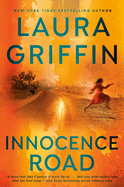
In Laura Griffin's gripping Innocence Road, the death of Detective Leanne Everhart's father prompts her to leave her position in Dallas for the Madrone Police Department in her west Texas hometown.
Her father's death "had thrown everything into chaos," forcing Leanne to deal with "her dysfunctional family," including her mother and meth-addicted brother. Leanne knows the locals resent her for leaving Madrone, while Police Chief Jim McBride resents that she came back and he had to hire her, due to pressure to have "at least a token female, plus the weight of her father's legacy." McBride thwarts Leanne at every turn during her investigation of the murder of a Jane Doe found on a "parched patch of desert" near Madrone.
McBride also ignores that a forensic anthropologist identified the remains of four additional women found near the same place over the years. He doesn't want more attention from the horde of journalists who arrive after the high-profile murder conviction of a man named Sean Moriarty is overturned. The court ruled that Moriarty's confession was coerced by the police, who included Leanne's father.
Griffin's evocative sense of place captures the minutiae of small-town life. Leanne misses "the life-altering freedom of being able to shop for groceries without someone peering over your shoulder" that she enjoyed in Dallas.
Innocence Road maps a strong plot buoyed by powerful characters like Leanne, whose tenacious personality enhances her skills as an investigator. Leanne has a two-fold determination for justice: as she pursues her own investigation, she's driven to find out if her father was partly responsible for convicting an innocent man. --Oline H. Cogdill, freelance reviewer