

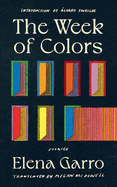
The Week of Colors is Mexican writer Elena Garro's first--posthumous, overdue--collection in English, exquisitely translated by Megan McDowell. Over 13 stories, Garro (1916-1998) seamlessly layers reality and surreality, creating hybrid worlds where multiple timelines, monsters, and childish imaginations coexist (not always peacefully) with what seems readily visually, aurally, and intellectually recognizable.
In the disturbing titular story, the enigmatic Don Flor proudly escorts two young sisters through his home, where he imprisons women named for days of the week, assigns them vices, then tortures them to "fit [each] with the virtue that would check her vice." Sunday's vice is "lust"; he viciously violates her so she might attain "generosity." Those sisters, Eva and Leli, return in multiple stories, revealing both their privilege as "little blonde girls" and their suffering as too often being treated as the lesser gender. Moving marginalized voices into the spotlight, Garro gives voice to an indigent villager desperately seeing work in the poignant "The Cobbler from Guanajuato," and to an abused Indigenous woman hoping for safe shelter in the shocking "The Tree."
Not unlike her characters, Garro was all too familiar with being personally, societally, and creatively stifled, and particularly overshadowed and oppressed by her husband, Octavio Paz (they were married from 1937 to 1959). Contemporary novelist Álvaro Enrigue's introduction provides illuminating contextualization of Garro's own literary significance, reclaiming her as a "bold innovator" who championed oppressed voices and noting her rightful recognition as the "inventor of magical realism." Six decades since its original 1964 publication, Garro's collection should entice new generations to discover her with fresh, open eyes. --Terry Hong