

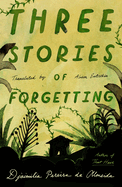
In Three Stories of Forgetting, Portuguese author Djaimilia Pereira de Almeida (That Hair) sharply and wrenchingly confronts terrifying colonial legacies in three novellas interconnected by suffering and (im)morality. De Almeida introduces three distinct narrators separated by centuries; these aging men struggle with debilitating memories of enslavement, war, and senseless violence as they confront grave acts of inhumanity both perpetrated by and forced upon each of them.
"A Vision of Plants" opens the trio, perhaps the collection's most powerful. Former ship captain Celestino has returned from countless voyages facilitating the heinous logistics of Portugal's slave trade: "He had burned down huts, cut off heads, and let everyone know it. And the world did nothing." He endures the last of his days trying to tame his "unkempt garden," its chaos not unlike his savage past.
"Seaquake" follows, jumping ahead to 21st-century Lisbon, presented as a father's epistolary confession to his estranged grown daughter, Aurora. He killed indiscriminately for the Portuguese military in his youth; now impaired by a hernia, he's barely subsisting, although he lives as if to make amends, extending kindness to his found family--an abandoned dog, a young runaway, an unhoused woman.
Slavery haunts again in "Bruma," the name of an enslaved 19th-century, 60-something footman. Voracious literacy--self-taught--allows him reprieve from his captive servitude, escaping to the "cabin" of his imagination. Bruma repeatedly blurs reality and the literary as a means of survival.
Despite the book's title, readers are unlikely to forget. Complacence is impossible as de Almeida exposes centuries of horror with demanding graphic detail in Alison Entrekin's haunting English translation. Forgetting is not a viable option. --Terry Hong