

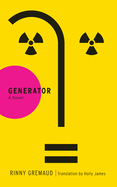
Korean Swiss journalist Rinny Gremaud's debut novel, Generator, provides a meditative examination of identity, provocatively conflating nuclear power with biological ancestry. Holly James smoothly translates from the original French. In 1977, the narrator was born at Kori, the site of a nuclear power plant in Busan, Korea. Her Korean mother's English fluency got her a job with a British company, where she met her daughter's father, a British engineer. Once reactor Kori 1 was complete, however, the father left Korea, abandoning mother and child.
Forty years later, Kori's shutdown is imminent, and this end of "the first atomic age" triggers a backward gaze for the narrator: "The word 'generator' resounded throughout my childhood.... It seemed to mean many things at once: generator as in genitor, birth, and spark. Generator as in father." The search commences to geographically trace "this absentee" across the world: "I'll constitute a genitor for myself from the little information I have." At 16, this genitor left his widowed mother to become an engineering apprentice in Wales. At 20, he spent 10 years with the U.K. lighthouse authority, then went on to a Wylfa nuclear construction site. After promising a local girl he'd return, he moved to Taiwan, where he would marry and father two children, before his "stint in South Korea."
Gremaud writes in first person, eschewing names, as if names--like her protagonist's--are unreliable. She uses "you" to address the missing father, unapologetically creating his life on the page: In the four decades of his absence, she's earned the right to imagine him to life--and then decide whether to hold or discard him. --Terry Hong