

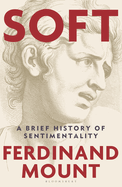
The different ways people express emotion go in and out of fashion, reflecting the values and conventions of a given era. In his expansive cultural history, Soft, Ferdinand Mount unpacks the current disdain for sentimentality as mawkish and insincere and argues instead that the emotional capacity for genuine empathy has occasioned great social change since the medieval period.
Mount (Big Caesars and Little Caesars) describes three "Sentimental Revolutions." The first, in the 11th century in Languedoc, France, celebrated romantic love. The second revolution occurred in the 18th century, prompted by the publication of Samuel Richardson's watershed novel, Pamela, and its "obsessive dwelling on the ramifications of one's inner feelings." The final revolution involved cultural shifts in the 1960s in Great Britain and the West. Each period provoked a reaction, which Mount notes constituted a "culture war." For example, Mount notes that Brexiteers such as Nigel Farage in the U.K. sneered at the notions of unity put forward by the European Parliament, which used "Ode to Joy" on its opening day in 2019. Similarly, contemporary ideas of men getting in touch with their feelings are often vilified by the political right wing in the U.S., in favor of harsher, more codified gender roles.
While Mount's research is exhaustive and immersive, it's his prose that makes his well-formulated argument a joy to read, such as when he highlights Henry III's "practical sentimentality" as having taken "the edge off the old feudal aggro, softened relations between the classes, as it did relations between the English, Scots, Welsh and Irish, to an extent seldom repeated in later centuries."
Soft will be a page-turner for readers of all stripes, regardless of how stiff their upper lip. --Elizabeth DeNoma, executive editor, DeNoma Literary Services, Seattle, Wash.