


|
|
| Chris Duffy (photo: Sela Shiloni) |
|
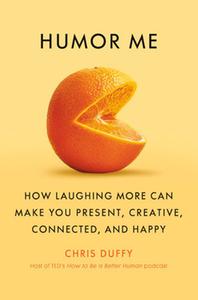
Chris Duffy is a comedian and host of the TED podcast How to Be a Better Human. His debut book, Humor Me: How Laughing More Can Make You Present, Creative, Connected, and Happy (Doubleday), showcases a deep commitment to interrogating the various utilities of humor, but with an appealing lightness, joy, and vulnerability.
One of the particular delights of Humor Me is all the research you pull in. I'm wondering what research rabbit holes you found most interesting.
I'm such a nerd. I love to learn about stuff. Getting to talk to all of these people about times when they laughed really hard, and what makes them laugh, and why they think it has a role in their lives was such a delight of the process.
For rabbit holes, I always like ones where I'm surprised. The nursing home in Hong Kong was exciting to me because the idea that a home with people who are at the end of their lives and needing a lot of care could also be a place full of laughter and humor and joy--it challenged a lot of my preconceptions.
Also, Nuar Alsadir's book, Animal Joy, tied so many threads together for me in the way that humor functions as a psychological tool for us and can connect us more deeply to our true selves, especially her idea that we're often told to behave, and that behave means behave less.
How did you balance research versus writing? Was it a simultaneous process? Did you finish researching and start writing, or how did that work for you?
I'll tell you the nuts-and-bolts process for me, as I'm very used to writing shorter-form stuff. I write a newsletter every week. I write podcast scripts. I have written for television. So I was very used to, "You need to write 20 pages, and it has to be done on Friday." The idea that you have to write 300 pages and it has to be done a year and a half from now was extremely daunting to me at first, because I am the kind of person who, if you give me a homework assignment that's due on Monday, I'm like, well, why would I even look at it until Sunday? And you just can't do that with a book. So the way that I avoided that was my editor agreed to do something which I've since come to learn is fairly atypical.
We had a very detailed outline of where the book was going. Each month, a new chapter was due, and my editor would give me feedback along the way. So I had deadlines. And that was so crucial for me, that part of the process, because it let us shape the book together, but it also let me do the research, write a discrete part, then send it in, and then at the end, I could make sure that everything was working holistically together, but it felt more like a series of assignments over the course of a year.
 That is fascinating. I don't know many editors who work that way, but I love that.
Yeah. I was very upfront with her. I was concerned there wouldn't be a book if we didn't work this way. She was like, "All right. I guess I'd rather have a book than not have a book."
I could see why that worked.
Even if you're not going to read it until the very end, it's extremely important to me that I believe 100% that you will be mad if I don't send it to you every month. I need to have a looming fear of someone being upset with me. That's the only way for me to write.
You mentioned in the book that you're an extrovert, and I was wondering if you could talk about how writing went, because it's such a private endeavor. And I know you just said that you turn something in monthly, but it's still a lot of time to devote just by yourself, in your head, on the page.
Totally. Well, as you can tell, I already forced it into the most extroverted possible way that it could ever go. I was like, what if instead of it being a year of me being alone, it was only a month? I'm extremely social, and I love to process my ideas with other people. One of the joys of comedy, especially a live performance, is that you get such a short feedback loop.
My serious, more earnest answer is I liked being challenged in the sense of this is not a way I would normally work. And I enjoyed seeing what it was like for me to do that. And I think I had the experience that many authors have, which is, man, it feels so good to have written a book. And, wow, was it not fun to write the book.
You included a number of funny anecdotes from your own life, including the LinkedIn prank and the tour you took at the Celestial Tea Factory in Boulder. I'm curious how you chose the examples. Is there a favorite story that didn't make it in? What was your process to figure out which ones went in, which ones didn't?
Well, you know, the honest answer here is that I've been doing stand-up comedy for a decade, and I have not put out a special because I was kind of saving the material. And this book, I was like, you know what? This is the time. Don't save anything. Put it all out. Use all the best stuff.
So this is the best hits.
Let me put it this way: No cream didn't make the cut, but a lot of stuff from the bottle definitely didn't make the cut.
I'm curious if there was a version of this book, either imagined or actual, that had less of you in it. I'm thinking of some of the particularly vulnerable parts you share about your wife.
Yeah, there was definitely a version that would have been less of me. I think in some ways that was maybe what I was imagining, but I was pushed by my agent and by the publisher and editor and pretty much everyone who read it--they all said, "We want to know more about you."
But I also think that what I really love, especially in nonfiction books, is the relationship with the author. I know how they're feeling, and I'm invested in them. And it's hard to feel like you yourself are worthy of that. You know, I'm just a normal guy. Like, why would anyone want to hear more about me? But then when I talk to people about it, I see, oh, well, that's relatable to other people. That's something that they've gone through as well. --Nina Semczuk, writer, editor, and illustrator