

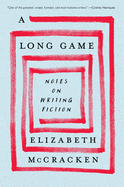
Perhaps the greatest gift of A Long Game is Elizabeth McCracken's assumption that readers of this book are writers, students in her class, and she is here to encourage them. But, in fact, even for those who simply enjoy reading, this book is a gem and makes an ideal gift for all readers (and secret writers).
"I believe in modes of thinking, not rules," McCracken (Thunderstruck) writes in one of the book's 280 numbered sections. "Occasionally a student will beg me for a rule. 'Just one,' the student will say. 'Something, anything.' I refuse," reads another. McCracken loosely organizes the honest, open, and pithy sections (some comprising two sentences, others two pages) into 10 thematic chapters.
One of McCracken's best tips is about breaking through "a block of any kind": Struggling with a title? "Generate as many as you can." An event? "Write at the top of a page, What can happen next? and then a list." She blows open clichés such as "write what you know" and "real writers write every day"; "me, I harness the power of my own self-loathing" to get work done, she confesses.
McCracken discusses narrators and timelines, critics and perfectionism and humor, and shares a terrific observation about plot: "Event is what happens in a story, but plot is the electricity between events, how events lead one to the next, working the way through the characters." Once at the beginning and again at the end she writes, "I'm talking to myself." Readers get to be her lucky witnesses to this funny, insightful, and instructive soliloquy. --Jennifer M. Brown