

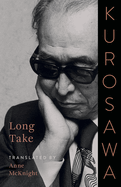
The great Japanese filmmaker Akira Kurosawa's Something Like an Autobiography, published in 1982, is one of the best cinema memoirs ever written. He lived until 1998, however, and directed several films after the book's release. One assumes that even a publicly reticent figure like Kurosawa had more to say. That assumption is validated by Long Take, a collection of essays and conversations originally published in Japan in 1999, most dating from after the previous volume. Translated from the Japanese by Anne McKnight, this excellent work, along with Waiting on the Weather, a 2006 book by Kurosawa's former assistant Teruyo Nogami, provides an indispensable companion to the director's autobiography and a singular look at his perspectives on film.
The opening essay by Kurosawa describes his experience making Seven Samurai (1954) and explains that, for the final battle sequence, "[Mud] really got in everywhere. All my toenails ended up turning black and falling off." In an essay on Maadadayo (1993), his final film, he states that he'd rather be known as an artisan than an artist, adding, "Above all, people should be entertained." In conversations with two interlocutors, he discusses, among other topics, the process of filming the eight tales that constitute Dreams (1990). Long Take concludes with several entries by his daughter, Kazuko, including her reminiscences of Kurosawa's final three years and a list of 100 films that constituted his "ideal cinema viewing experience," among them Bicycle Thieves, Barry Lyndon, and, delightfully, the original Godzilla. Cinephiles need this book. --Michael Magras, freelance book reviewer