

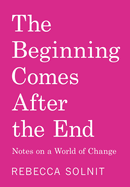
Perennial favorite Rebecca Solnit (The Mother of All Questions; No Straight Road Takes You There) understands the despair that can arise in a world that seems hell-bent on harm and hurtling toward a destructive end. Noting the many ways that real change can be rendered invisible, The Beginning Comes After the End encourages readers to reject the "short-term perspective" in which "the present seems to be perpetual, unchanging, unyielding" and "no old world is dying, no new world is being born." As is typical of her work, Solnit draws upon myriad writers, thinkers, and activists to illustrate her points that the world is thoroughly interconnected and that "the past shows us how change works, how what once seemed impossible becomes actuality."
Though unnecessarily repetitive at times, Solnit builds a compelling argument that the dissolution that seems to threaten the social progress gained in recent decades is instead merely a backlash that she likens to a supernova. She cites astrobiologist David Grinspoon's assessment that what seems "as if they were gaining strength and becoming something larger or more powerful" is just a star's collapse at the end of its life. And from this destruction, Solnit argues, will come something new, something to build together. Perfect for readers of Robin Wall Kimmerer and David Graeber, Solnit's work offers an invitation to see the world and its capacity for change as a home for hope, asking, "What futures can we build on these other versions of the past, these other voices with other stories to tell?" --Sara Beth West, freelance reviewer and librarian