

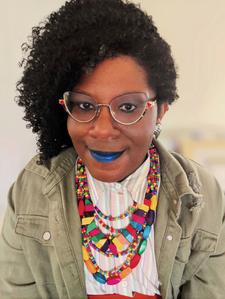
 Violet Allen is a science fiction and fantasy author whose short stories have appeared in Lightspeed Magazine, Best American Science Fiction and Fantasy, and more. Plastic, Prism, Void (LittlePuss Press) is a riotous, experimental debut novel that follows the time-hopping trans romance between a magick demi-goddess and a mech pilot from another dimension.
Something that absolutely hooked me on this book was the protagonist. She is so gorgeously layered and messy. Can you tell me about the process of writing such an engaging person/Moth Queen?
Acrasia is fun to write because she's a comically exaggerated version of myself, possessing all of my flaws and few of my virtues, voicing my meanest opinions and acting out my impulses. Originally I came up with her for a different project that fell through, but I was so enchanted with her as a character and a voice that I tried to find the perfect story for her, which turned out to be this book.
She's so brash and there's this intense love/antagonism with her friends. But I thought her vulnerability came through almost immediately and made me relate to her. Do you see her as one of the unlikable female characters we talk about these days?
Well, she is openly abrasive. At best she's nice to her friends--kind of? In a lot of fiction people want women to always be nice and show a soft side. And in some progressive circles, Black trans women have become a signifier of wisdom and are assumed to have special activist powers. Acrasia is pushing against that. She doesn't want to be wise, she wants to be smart--and she wants you to know it.
So she's not fitting the box we want to put women--and specifically Black trans women--into?
Yes, she knows that box is there and is purposely pushing on it. I would also say that sometimes these discussions miss that unlikable characters and unlikable people are different. I wrote her to be likable as a character--she's funny and entertaining--but you maybe wouldn't want to be her friend in real life. The likability of female characters is often tied to agreeableness and pleasantness rather than being someone you enjoy reading about. So Acrasia wants to be likable and lovable, but on her own terms, which in some situations can be very admirable but in others can be deeply frustrating.
 I think that's a fascinating distinction because I often find characters I really enjoyed reading getting labeled as unlikable. I wonder about the social constructs that are underlying those labels.
I thought a lot about how there are many different qualities that get grouped together as unlikable. There's definitely misogyny there in the way women are judged more harshly, but also some of that is affected just by the mechanics of how books work. There's relatability vs. being interesting vs. admirable qualities like heroism or kindness. Different readers are attracted to different things.
I do think Acrasia is nicer than she lets on. A lot of her abrasiveness is a pretty shallow performance. So she doesn't actually like violence, but she likes to act like she does. She wants to project that she's tough and mean and decadent, despite being a fairly soft, sensitive person. She's also extremely needy but can't admit that. She wants the reader to like her, but she spends a lot of time negging them, like, you don't know as many languages as I do, you haven't read as many books as me, you didn't go to as good a school as me, but you should love me anyway.
That comes through when she starts breaking the fourth wall and addressing the reader in a very specific way I haven't seen before.
It's inspired by a lot of things, but I would particularly shout out Grant Morrison, a Scottish comic book writer who's famously very weird and metafictional. They call out that you're reading the comic book and then it affects the story in a lot of their work. I've always liked metafiction and writing that does weird things with form and voice.
I had such complicated feelings about Opus, which I think is a testament to a well-written character. Tell me, should I love him or hate him?
I mean, yes? I really like Opus, but he is meant to be a really difficult person, just as Acrasia is meant to be a difficult person. Often he's not necessarily wrong in his opinions, but he's being a dick about it. So he might be right that Acrasia's making bad choices. Or that she's trying to manipulate him. But he does not react in a great way.
Is there anything in particular about the trans themes here that you'd like to speak to?
So much of how I see these characters is influenced by their trans experience, even if it's not discussed directly. Acrasia is rebelling about conceptions of Black trans women being wise. And Opus is doing this exaggerated performance of masculinity.
Part of what they like about each other is that they're both doing a bit of a camp performance. There's more backstory about that coming up in the second book. There's this trap as a trans person: you might be seen as gender non-conforming before you transition and then afterwards you're suddenly a stereotype. It can of course be a benefit in mainstream society, but it changes how you are seen in queer, progressive spaces a lot. Both Acrasia and Opus experience that weird energy as they navigate the world. The second book gets more into that.
I can't wait to read part two. What are three books you recommend reading in the meantime?
First, The People of Paper by Salvador Plascencia is a very strange kind of magical realism novel that uses a lot of unusual typography and text formatting, similar to what I do.
Also, Oreo by Fran Ross, which is about a mixed-race Black Jewish woman searching for her father in 1970s New York City. It's maybe the funniest book I've read in my life?
Then I'd recommend Notes from a Regicide by Isaac Fellman. It's a far-future trans family saga about a trans couple and their found-family adopted son. It follows the son as he comes to terms with the history and reality of these two people that he only knew in the context of being his parents. --Carol Caley, writer