

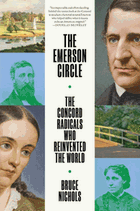
In the 1840s, a group of freethinkers and intellectuals in Concord, Mass., set out to transform the world and unleash the individual spirit. Bruce Nichols deftly explores their movement in The Emerson Circle. The antebellum United States enjoyed a "market revolution" of "expanded... manufacturing and transportation systems," but it also experienced something "truly new," Nichols argues: "an intellectual revolution." Centering on the popular lecturer and essayist Ralph Waldo Emerson, this "circle of friends" challenged traditional notions on art, culture, and society, seeking to transcend them. This movement, called "the Newness," had Emerson as its "fountainhead," and included luminaries such as Henry David Thoreau, Margaret Fuller, Nathaniel Hawthorne, and Bronson Alcott--and his daughter Louisa May--to name a few.
Nichols crafts an appealing narrative of this brilliant set of Americans, quoting liberally from their letters while analyzing their often-complex relationships with one another. They sought to reform the country and reinvent society--communal living and vegetarianism were but two of the group's outward manifestations--but, as Nichols shows, the country's bitter divisions over abolitionism and slavery forced the Transcendentalists to develop from talk of "the Over-Soul to realpolitik." Nichols offers a key insight into how the "two issues... [of] war and slavery" transformed the Transcendentalists themselves, moving them from "philosophical contemplation and idealistic thinking" to more overt public activism on behalf of antislavery causes. Although meandering at times, The Emerson Circle is an illuminating introduction to the country's first "radicals" and their lasting impact on U.S. letters. --Peggy Kurkowski, freelance book reviewer in Denver